Christian men need all of the help they can get staying true to the high calling of the Gospel and staying faithful. Just as important, says Matt Lobel of Out of the Wild, is for men to find the mission God has for them. It's a message profound in its simplicity.
As Jake and Elwood famously said: "We're on a mission from God."
We're On a Mission from God
Friday, December 29, 2006

Top Religion Stories of 2006 Include the Evangelical Climate Initiative
Thursday, December 28, 2006
Grist on ECI:
Observing the news of faith and values—what some call religion news—as a professional discipline for more than 28 years, perhaps the most enduring truth is that in the spiritual realm, very little is truly breaking news.
Matters of the spirit--coming to faith, spiritual conversion and formation, and the movement of God in the lives of his people—are rarely headline news. Although matters of faith can at times be personally dramatic, and there are certainly moments of change and first steps in spiritual journeys, these journeys are usually slow and sure. The most important matters of the heart are quiet, personal, and usually quite deliberate.
Which makes our job in the Christian communications business challenging. Most of the really important stuff isn’t news at all. It is God quietly at work in the hearts and minds of people.
But from time to time, God’s people make a difference in a notable way, stand against the culture in bold ways, and—yes—mess up in embarrassing ways.
These are all reflected in Christianity Today ‘s top religion stories of 2006. They include the sad Haggard free fall, the evangelical response to The DaVinci Code, and the story that our firm helped bring to the world—the Evangelical Climate Initiative. (ECI also made Grist’s list of top ten green stories).
CT on ECI:
“Observers say global warming debate signifies broadening political agenda.”
Grist on ECI:
“It was the most public episode in what's been a building drama among evangelicals, pitting the old guard, which plans to keep flogging gay marriage until the checks stop coming, against the new guard, which is pushing to broaden the agenda to issues that involve fewer clear villains but actual, widespread suffering: global warming, poverty, and AIDS.”
The Nanny City Watching Your Diet
Wednesday, December 06, 2006
Welcome to New York City, where we watch your diet, even if you won't. Jenny Craig, mayor.
NYC's effort to ban trans fat has been in the works for a while, but it's hard to believe that anyone believes it is the job of government to determine what we eat. I love that Wendy's and others are taking corporate responsibility and removing trans fats from their products. That makes it far easier for consumers to make wise decisions. But how does anyone find a role for government in these personal decisions?
Christians and Conservatives Give More to Charity, ABC Says
Friday, December 01, 2006
Christian conviction and conservative ideology increases the likelihood that an individual will give to charities—and not just to their churches, but to a variety of religious and secular causes.
As Christians, we give out of obligation—Scripture tells us to help the poor—but even more out of gratitude to God for his goodness.
Liberals who see care for the poor as a government responsibility, give far less as individuals. At the same time, they describe conservatives as non-caring, and Christians as exclusionary and hypocritical. This could not be further from the truth, and these findings document it.
People of faith give far more to charities than non-religious people, and conservatives give more to the poor than do liberals. That’s the finding of a study by author Arthur Brooks and the conclusion trumpeted by a John Stossel report on ABC 20/20 this week.
The report says:
“The single biggest predictor of whether someone will be charitable is his or her religious participation.
Religious people are more likely to give to charity, and when they give, they give more money: four times as much. And Arthur Brooks told me that giving goes beyond their own religious organization:
"Actually, the truth is that they're giving to more than their churches," he says. "The religious Americans are more likely to give to every kind of cause and charity, including explicitly non-religious charities."
Christian conviction and conservative ideology increases the likelihood that an individual will give to charities—and not just to their churches, but to a variety of religious and secular causes.
As Christians, we give out of obligation—Scripture tells us to help the poor—but even more out of gratitude to God for his goodness.
Liberals who see care for the poor as a government responsibility, give far less as individuals. At the same time, they describe conservatives as non-caring, and Christians as exclusionary and hypocritical. This could not be further from the truth, and these findings document it.
Ten Ways Media Leaders Can Keep Media Ethics from Becoming an Oxymoron
Wednesday, November 29, 2006
After reading a list of oxymorons, beginning with George Carlin’s famous “jumbo shrimp” and “military intelligence, I got a minor laugh in my college course on writing for public communication by introducing as the next oxymoron, Media Ethics. It introduced a section on the Society of Professional Journalists Code of Ethics and I suggested the following list of ten ways the national media could restore its reputation.
1. Accuracy: Attention to detail; accuracy at all costs.
2. Thoroughness: Emphasize thoroughness over speed; getting the story right is more important than getting it first.
3. Humility: demonstrate humility through preparation, broad and vigorous research, and by seeking out experts.
4. Real Affirmative Action in news operations: ideological, religious, regional, and socio-economic, as well as racial and ethnic.
5. Journalism not Opposition: Reaffirm journalists as reporters of news, not the opposition party.
6. Historic Values: Reflect traditional values of the nation—ethics, historic teachings of faith groups.
7. Thinking: Recover the serious and critical mind—beyond the sound bite.
8. Rediscover Shame: wrongdoers should not be honored, they should be dishonored.
9. Self Cleansing: Restore credibility by cleaning up your own house so that journalists are trusted to present news fairly and professionally.
10. Leave NYC: Build national media competence and presence outside New York City and Washington, D.C. It would be good if the major networks moved to Des Moines, or Kansas City, or perhaps Indianapolis.
These were my thoughts for one group of future journalists.
-- Jim Jewell
Monday, November 27, 2006
Mocking Christian Conviction, Happy Feet is Not a Friendly Little Film
I can't remember coming out of movie theater more furious than I did this Thanksgiving holiday after watching the animated and PG-rated Happy Feet. With relatives visiting from around the country, how could we go wrong taking both kids and adults to a cute little penguin story with lots of singing and dancing, with warm and fuzzy animal themes?
I'm not a movie prude; we check out many kinds of movies. And I expect most anything coming out of Hollywood, with any rating, to include something contrary to my values. I let most of it roll off my back. But with Happy Feet, I didn't expect my conservative Christian family to be assaulted with what we all recognized as a anti-Christian screed, with open mockery of traditional Christian preaching against values and lifestyles contrary to church teachings. It was abundantly clear that Happy Feet substituted homosexuality with dancing as the "different" lifestyle that was the unfair target of an Inquisition on ice. It was Dirty Dancing and Footloose all over again, but with the rhetoric and situation developed to make religious criticism of homosexuality counter to everything good and pleasing.
Did they think Christians wouldn’t notice? I suppose the creators just didn’t care. We had four families attending Happy Feet, with children of all ages. Independently, parents concluded during the film that they would walk out if it wouldn’t be a disruption to others in the large group of family members who had come to the movies together.
Clearly, we should have all left together.
The creators of Happy Feet should have taken less time mocking Christians and more time making sense out of the wild leaps at the end of the film, when the dancing penguin so impresses crowds in the aquarium that they release him back into the wild. And when the community of penguins gets happy feet, the commentators of the world decide its time to stop disrupting their food supply. (Of course the humans are to blame for all the animal woes; a long movie-making tradition that goes back to Bambi).
Wild leaps, even with happy feet.
For Christians who have not seen Happy Feet and are considering it as a friendly, family film—make another choice. This film is not good for children or families, and it is another Hollywood example of open mockery of Christian traditions.
-- Jim Jewell
Getting Personal About Global Warming
Monday, November 20, 2006
I've been at the heart of the evangelical initiatives to engage the Christian community in an effort to combat human-induced global warming. For my conservative friends who still believe that all climate change we're seeing is simply cyclical, keep reading, because I'm not writing to argue that point (you wouldn't be convinced anyway, although the huge majority of scientists are). For my fundamentalist friends who belive there is no global warming, I'm not sure what world you're living in, but I hope you are enjoying it there.
I've found that most evangelical Christians have come to believe that effective care of God's creation is a moral and spiritual obligation. Not because nature is above human beings, or that the created are above the Creator, but because the earth and all that is within it is the Lord's and we, his children, have been given it as a temporary home, and we've been given the responsibility to care for it.
And if you believe that climate change is impacting the most vulnerable people in the world, as I do, and that it will be deadly for many of these people who live on the margins in the years ahead--then Christians have a deep moral responsibility to stem global warming.
You may not see the solution as government taking responsibility. That's fine, but it is a personal reponsiblity.
As evangelicals we are all about getting personal. We believe in a personal relationship with God through Jesus Christ. We believe in personal transformation and personal responsibility. We can also address problems such as environmental degradation and dependence on foreign oil not only through government action but through personal responsibility.
This personal responsibility can include reducing our own use of fossil fuels.
Choose to do this for a variety of reasons. You may be keenly concerned about global warming. Others of you may see environmental conservation as a driving force. Still others of us believe that reducing our personal use of energy is a commitment to national security because it will reduce our reliance on oil from often-hostile sources.
Regardless of your reasons, I encourage you to consider using a tool created by the Evangelical Climate Initiative to participate in a program called Cooling Creation, which will show you the steps to reducing your global warming pollution to zero. Because few of us in the West want to live in grass huts and grow our own food and walk everywhere, we can reduce but not eliminate this personal pollution.
The Cooling Creation program offers an annual offset investment in alternative energies.
Check it out. Forget the arguments about the role of government and the threats to the economy. Is there a good reason why you should not take this personal responsiblity?
New Bloggers on the Election
Friday, November 10, 2006
In addition to my work as a public relations consultant, I am an adjunct professor of communications at Kennesaw State University, the third largest university in Georgia, in suburban Atlanta.
In two of my Writing for Public Communication classes on Tuesday, Election Day, I used a session on Writing for the Web to guide the approximately 40 students in using Blogger to set up personal blogs. It was my attempt to teach about blogs and to add a number of new voices to the blogosphere.
The assignment for students this week was to write and post an article on their reactions to the election (the assignment was made before we knew it was going to be a bloodbath). I’m using this post to introduce these new blogs and students’ analyses of the election.
For my students reading this, links to the blogs from the 3:30 and 5 p.m. classes are combined here.
Danielle at Dani B. Fly doesn’t expect much from the change in Congressional leadership.
Ken at Random Cactus says the Democrats won because they dressed themselves up like conservatives.
Laura called her blog For Com 1135 and writes that she doesn’t like all the arguing.
Holly at Poof U fears that the Democrats are going to use their new power to create the embarrassments of Vietnam.
Kori at a blog she called Communications 1135 is nervous about the many voting problems she still hears about.
Kathy writes at Kute Kathy about evidences of election fever.
Jonathan at Elbows wants political reform but doesn’t see it happening in his lifetime.
Adam at What’s On Peace’s Mind? is going to get more involved in the political process.
Victoria at Victoria’s Blog says that without the Republicans in control of Congress, the job in Iraq will never be completed.
Paul Stippich at Vote for the Man celebrates the right we have as citizens to vote.
Danielle at Faerie's Journey into Public Communication muses about the impact of split government.
Erin at The Story of the Year bemoans the impact of Democratic control of Congress.
Curtis at Me and My Blog is hoping for a new direction in Iraq.
Jennifer at Sobes 1st calls for a big hallelujah.
The negative advertising turned Catlin at Merry Belle Loves You against the election.
Monique at Fairie’s Thoughts sees the political landscape changing.
Jeff at Elections sees supeona power taking over the Washington atmosphere.
Matt at My Thoughts 4 U sees America as the perfect working democracy, but he doesn’t vote.
Jeffrey at The Wonderful World of Life is disenchanted
Dustin at Budz Blog is leaving politics to the politicians
Danielle at TFC for Life blames the war.
Rebecca talks in Comm Class about the President’s use of the word “thumpin” in his press conference.
Rachel at Ramblings of RKL has a rare agreement with the President: The people have spoken and its time to move on.
Endia at Endia’s Blog is excited about a new direction
Bunmi at Express Yourself likes the idea of a female Speaker
Jennifer at J.P. Blog analyzes the Sonny Perdue victory over Mark Taylor in the Georgia gubernatorial race.
Tiffanie at some days you feel like a bug, some days you feel like the windshield says the war has been a windshield to the American bug.
Casey at Voting celebrates the the right to vote.
The title of Nate's blog, Long Live the new Flesh, vividly describes his reaction to the election.
Rania at Nia's Thoughts hopes the sea change will bring more attention to domestic problems.
-- Jim Jewell
A Story of Forgiveness from Africa
Saturday, September 23, 2006
I searched for answers in the eyes of the three Acholi men huddled with me in the corner of an outdoor café on the leafy outskirts of Lira, a major city in northern Uganda. I had met the youngest of the three, Patrick, three days earlier and knew him to be a former child soldier, abducted at nine and in the ranks of the LRA rebels for ten years. Patrick, I learned, was piecing together a new life in the grip of Christian faith and good friends.
Patrick had brought me to the café in the early light of a July day to meet with the other two. Charles was a tall, handsome man with remarkably troubled eyes that I figured must be partially explained by the events that led to amputation of one of his legs below the knee. I had met Charles the day before but hadn’t found out how he’d lost his leg. I was trying to talk with a young woman named Janet, one of the “famous” Aboke girls who had been abducted by the LRA from St. Mary’s Boarding School ten years ago. She had spent most of the past decade in captivity. Charles was introduced to me as Janet’s husband, and as the first person I needed to talk to in order to meet her.
Now, with his crutches propped against the wall behind his chair, Charles leaned toward the man we had all gathered to see, known to me only as Mark.
Mark is a large, imposing man resembling James Earl Jones in stature and visage, particularly Jones’ role as Rev Stephen Kumalo in the movie version of the South African classic on reconciliation, Cry, the Beloved Country. Like Kumalo, he is a pastor. He is also Janet’s father, who Charles had explained mysteriously “held me responsible for what had happened to her.” That mystery was one of many to be unfolded around the table.
Mark was understandably protective of his daughter, no longer a young girl, but one who had begun to see too much of the dark side of life before her 13th birthday, when she was enslaved by the LRA and forced into a life of servitude.
As the café brightened, Mark explained his protective instinct, and much more.
Charles, the pastor said, had himself been abducted nearly 20 years ago, in the early days of the twisted rebellion. He was 17 at the time, and like an early adopter of a pyramid marketing scheme, he was soon one of the commanders in what was to become a ferocious and by any standard evil force that continually increased its ranks with abducted children, some 30,000 over the years.
As young abducted girls came of age, they were given to commanders as—you pick the term--wives, concubines, sexual slaves. It was a privilege soon afforded young Charles, and over the years he was presented with four women; a harem that bore him 10 children.
Janet, Mark’s daughter abducted at Aboke, was one of these young women, and by Charles she had two children in captivity, in the bush--as they say in Uganda.
“When Janet was rescued with her children by the military, and she came home, I wanted to kill the man who had forced himself on her; I wanted to kill him with my teeth, I was so angry,” Mark told me, with Charles, that man, sitting beside him.
Then Charles was captured in a firefight with the Ugandan military, by that time already having lost his leg in an earlier battle.
“Then something strange happened,” Mark continued. “God made it clear to me that I was to forgive Charles for what he had done to my daughter. And only God can give you the strength to forgive such terrible acts.”
Charles produced two wallet photos, one of he and Janet with their two children smiling with a white background, looking very much like the young family that went to JC Penney for family photos in a coupon deal. The other photo had the family, with Charles and Mark shaking hands.
“Not only did God tell me to forgive, he told me to reconcile, to make this man, the husband to my daughter, my son. I have done that.”
Charles looked admiringly at the imposing man and told how Mark meets with him regularly and gives him regular counsel and admonition.
“I’ve told him that he must give his life to Christ,” Mark emphasized.
I marveled at his ability to reconcile so decisively and at how this seemed to come easily to the Acholi, who are offering amnesty to the vilest rebels. Mark agreed that it was remarkable, but said it was also extremely difficult. “It is tough. Only in God’s power can you look beyond such offense and agree to love.”
I talked briefly with Patrick, as Mark and Charles discussed plans for later that evening. Patrick continued the description of the reconciliation between the respected gentleman and his son-in-law.
Mark stopped our conversation mid-sentence: “What is this that I hear you saying? My son-in-law? That is not right. No,” he said looking intently at Charles, “this is my son.”
--James Jewell
Possible Peace, Little Trust in Northern Uganda
Friday, September 22, 2006
Since my return from Uganda in late July, I've been following the sitution in northern Uganda with interest.
It is difficult to get reliable reports out of Uganda about the peace talks with the Lord’s Resistance Army (LRA). While there have been reports of a peace deal, and even indications that up to 1,800 rebels have moved to designated areas, the talks continue. One hang up to total resolution is the international court indictments of rebel leader Joseph Kony and his commanders. Uganda is willing to grant amnesty, but the ICC hasn't agreed.
Today, there are indications that Museveni (president of Uganda) is going to attend the peace talks in Juba.
While peace talks continue between the Ugandan government and the LRA, the Acholi people of northern Uganda, 90 percent of whom are displaced by 20 years of terror, pray for peace but find little reason for concrete hope.
There have been at least seven unsuccessful attempts over two decades to secure a peace agreement, and many were followed by spasms of LRA violence.
“People will stay in the protected internal refugee camps until they have enough confidence that the attacks won’t begin again, and that hasn’t happened yet,” said Doreen Achieng , a program director with Action for Children, a Ugandan social service agency.
Some residents are leaving the camps during the day to farm their land near their abandoned or ruined homes. But almost no one has enough trust that the current lull in attacks will last to live in their villages and face nights that so often have been filled with horror.
For now, most of the villages remain empty, the land dotted with the graves of more than 12,000 friends and family members killed by the LRA.
The challenge for the church is enormous.
“Ugandan church leaders struggle today to assure their flocks of God’s love when many cannot remember a time without deep sorrow,” said Conrad Mandsager, executive director of ChildVoice International, one Christian organization that is providing aid to child victims in the Gulu district. “The scope of the horror and death that the people of northern Uganda have seen and experienced is unfathomable.”
The government of Uganda, recognizing the fundamental victimization of the child soldiers, offered them amnesty last year, which made it more attractive for even long-time rebels to escape. Prior to the peace talks, the government extended the amnesty to Joseph Kony and senior rebel commanders who would abandon their rebellion. The offer, although not yet accepted by the senior rebels, is in accord with a traditional Acholi heart for forgiveness.
Most church leaders support the principle of Kony and his commanders being offered amnesty, viewing it as their Christian duty to forgive.
"In fact, we want them to return home and live a normal life like everybody else,” said Rev. Willy Akena, information officer for the Anglican Diocese of Northern Uganda in Gulu. “It would also be a testimony to those in the communities to know about reconciliation, and I believe many people will be changed as we expect that upon their return, they will publicly denounce their previous atrocities."
Nonetheless, some churchmen don’t see the desire for peace as a reason for pardoning the ring leaders.
“The amnesty is not right for Kony and the commanders,” said one Acholi lay leader now in Kampala. “They are international criminals who the U.N. should apprehend in Congo, where the LRA has set up their camps.”
As in most areas of Uganda, there are Anglican, Catholic, Baptist, and Pentecostal churches in most communities. But in the north most stand empty, since almost all families have been forced by the violence to move to one of 60 protected internal displacement camps (IDP).
All families in a village do not move to the same IDP camp, however, so church and social communities are shattered, not just moved. Many pastors do their best to gather new congregations in or near a camp, but they are usually starting from scratch.
Spiritual interest remains high, and many small non-affiliated churches are being established in the camps. The lack of accountability and theological training has resulted in false teaching. “For example, part of the teaching is that people who are victims of atrocities are sinners and that the rebel activity is God's way of removing sinners,” Rev. Akena said.
--Jim Jewell
The Last Sin Eater Part of Hollywood Trend; Believe Pictures Will Be in the Middle of It
Thursday, September 21, 2006
There is a notable development in Hollywood that should be of interest to Christians. There is a new interest in things of faith and in products that reflect faith and values. Although many believers in the entertainment industry are now involved, the impetus is the millions of dollars that Mel Gibson made on The Passion of the Christ. People in Hollywood like to make money, even if it means advancing the Gospel.
The New York Times noticed this yesterday.
My former World Vision colleageue Brian Bird , who went on to become executive producer of Tourched by an Angel, and Michael Landon Jr. are in the middle of this good news, and their new Believe Pictures has signed a deal with Rupert Murdoch's new Fox Faith division for six films that will highlight faith.
The first film from Believe Pictures will be The Last Sin Eater, based on the novel by Francine Rivers, which was terrific.
Jan at A View from Her has more to say on this.
Hugo: Thank you for visiting our country. Now go home.
Wednesday, September 20, 2006
There is really only one thing to say after listening to clownish behavior of Venezuela's Hugo Chavez. "Say No to Citgo." I think I would push my car before I'd stop at a Venezuela-owned Citgo station. Citgo has been owned by Petróleos de Venezuela, the national oil company of Venezuela, since 1990.
The beauty of America is that Hugo and the Iranian president--whose name I don't even want to learn how to spell--can come onto our soil and verbally soil our nation and its leader--and leave again without being thrown in prison or taken hostage.
Try it in either of their countries.
There is part of me that would like to make it a little difficult for them while they're here. Maybe just a U.S. fighter squadron escort out of our airspace, with no invitation to return.
When the Messenger Falls
Tuesday, August 15, 2006
I like Mel Gibson and I honor him for his courage. I pray for his restoration and healing. He found a way to bring the story of Christ to the big screen; perhaps he’ll find a way creatively to help diminish the anti-Semitism that is a curse in the world and a unsavory legacy of Gibson’s own family.
--Jim Jewell
It was tragic when the man who is responsible for introducing Jesus Christ to more people than anyone else in our generation demonstrated great public sin and enormous personal problems.
That man, of course, is Mel Gibson, the film star, director of The Passion of the Christ, and evangelist, who accomplished a late night trifeckta—-public drunkenness, driving under the influence, and scapegoating an ethnic group, the Jewish people.
I grieve for Mel Gibson, because he clearly has deep personal issues that have now destroyed his reputation. And I grieve for the impact this has on the fine work he has done bringing the message of Jesus through the thicket of Hollywood opposition to millions of people. When God’s messengers prove to have feet of clay, it gives courage to those who would tramper upon the message.
But much has been written about this incident. I appreciated a column from Terry Mattingly, which included this thought from film critic Michael Medved, an Orthodox Jew.
"When a long-married, 50-year-old father of seven gets arrested for drunk driving at nearly twice the speed limit at 2:30 in the morning," noted Medved, "it's safe to assume that he faces even more serious problems than exposing his anti-Semitic attitudes."
I like Mel Gibson and I honor him for his courage. I pray for his restoration and healing. He found a way to bring the story of Christ to the big screen; perhaps he’ll find a way creatively to help diminish the anti-Semitism that is a curse in the world and a unsavory legacy of Gibson’s own family.
--Jim Jewell
War Coverage and Moral Equivalence
Monday, August 14, 2006
Certainly there is no moral equivalence here, with the Hezbollah terrorists responsible for attacking a legitimate and democratic nation. But journalistic balance should not infer moral equivalence, although it takes some wisdom by the reader/viewer (always a risk) to separate the morality from the equivalence of human tragedy.
It's an interesting article on a tough daily struggle for responsbile news organizations.
--Jim Jewell
Photos and TV images are the most difficult to balance in journalistic reports, according to an article in the NY TImes, and the Hezbullah/Israel conflict has been among the most difficult, the article says.
But the attempt to balance the photo of a dead Israeli child with that of a dead Lebanese child is seen by some as "a dereliction of journalistic duty.:
"Some critics of Israel argue that because the death tolls and destruction are greater in Lebanon, a proportionality of sorts should inform the resulting reports; anything else betrays a pro-Israeli stance. But supporters of Israel say such an approach bestows a misguided moral equivalence. Israel is a democratic nation exercising its right to self-defense, they argue, while Hezbollah is a terrorist organization that uses the Lebanese people as human shields."
Certainly there is no moral equivalence here, with the Hezbollah terrorists responsible for attacking a legitimate and democratic nation. But journalistic balance should not infer moral equivalence, although it takes some wisdom by the reader/viewer (always a risk) to separate the morality from the equivalence of human tragedy.
It's an interesting article on a tough daily struggle for responsbile news organizations.
--Jim Jewell
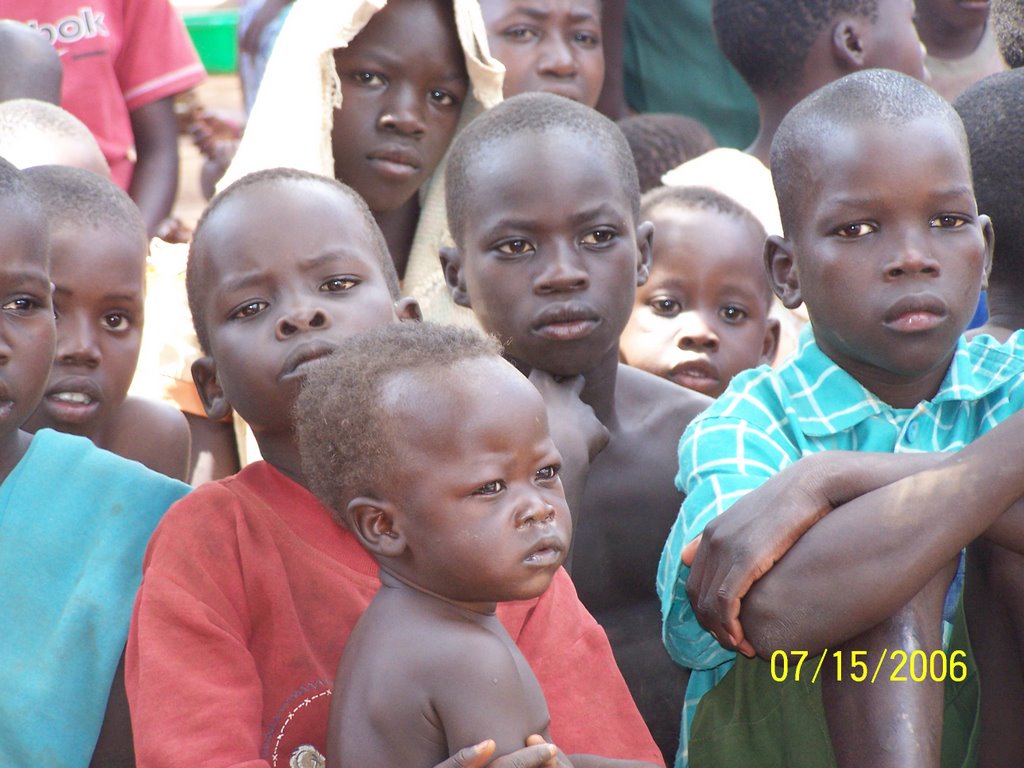
Journey to the Edge of Ugandan Darkness
This is Crisis
Occasionally, God puts us in situations where we are forced to realize that we are truly fortunate, and that the events and challenges that we call problems, are truly minor inconveniences in a sea of ease.
We returned several days ago from two weeks in Africa, mostly in northern Uganda, with a few days in Nairobi, Kenya. We were working with Child Voice International, a new Christian organization focusing on the child victims of war.
Although I’ve traveled extensively throughout the world, including a fair amount of time in the poorest countries, the time in Uganda provided a fresh dose of reality, of perspective, of gratitude, and of conviction.
Uganda
Uganda shares with most of Africa the tragic legacy of post-colonial cultural and economic freefall. Actually, the nation has been doing a little better in recent years than many of its neighbors, and because of the influence of the Christian church, it has a better record in its battle with AIDS than much of Africa. (You see abstinence posters everywhere. It’s not a bad word in Uganda).
Thirty years ago, Idi Amin brutalized the nation. When we flew into Entebbe, the world was observing the 30-year anniversary of the successful Israeli rescue of its citizens who were hijacked to Entebbe. Our Uganda guide and friend, however, did not want to talk about it. It is not a proud chapter in Ugandan history.
But now another madman has taken a severe toll on the nation. A deranged rebel spiritualist/terrorist, Joseph Kony, has killed thousands, adducted and enslaved some 30,000 children, and displaced most of the population of two million in the northern provinces of the nation.
One formerly abducted child we met at a transit center, James, had been forced by the rebels to bite his brother until nearly dead, then to beat him to death. At one point in the bush, James took some corn because he was hungry, and a rebel cut off part of his ear because he had not been given permission.
These stories are everywhere. Most families in northern Ugandan have lost a loved one.
When Will They Be Able to Go Home?
There shouldn't be malnutrition in northern Uganda, where the soil is fine and the rains are plentiful. But the murderous attacks of the oddly named Lord's Resistance Army have caused most of the two million people in this region to leave their homes and farmland to live in protected internal refugee camps. While these camps are relatively safe, people are crowded into them and diseases are killing thousands of people. And there is no land there for these people to grow their crops. They are kept alive through the help of international aid agencies.
Once the LRA rebels are subdued or give up, it should be safe for these refugees to return to their homes. But will they feel safe? Will they want to return to homes that have often been scenes of horrible crimes?
Thousands of Children Still Enslaved
According to one source who was abducted at the age of nine and served 10 years as a child soldier, during the which time he became a high-level LRA operative, there are still more than 3,000 child soldiers held by the LRA.
There are peace talks grinding on in Sudan between the LRA and the Ugandan government. Pray for this peace.
The government has offered amnesty to the butchers of the LRA. It blows your mind, but it fits into a culture of forgiveness, which I’ll talk about another day.
--Jim Jewell
YOU'VE HEARD ABOUT THE INVISIBLE CHILDREN OF UGANDA

Here Are Ten Things You Can Do to Make a Difference
1. Pray This Month
Pray every day for the next month for a specific situation facing child victims of war in Uganda (click here for a prayer guide).
2. Buy a Brick
Donate $1 to cover the cost of one brick which we will use to put up buildings that will make up the new ChildVoice Uganda community in Lokodi.
3. Show Off
Cool ChildVoice T-shirts can be purchased by contacting info@childvoiceintl.org. Wearing one helps pass the word about kids in the war zone that need help.
4. Rattle a Politician's Cage
The terrorists killing families in northern Uganda need to be stopped. Find your Senators or Reps. Then write a letter; make a call.
5. Raise Some Cash
You may not have a lot of cash right now, but you and your group can think of ways to raise some to help meet the immediate and long-term needs of these victims of war. Plan a fundraising event for this fall and send the proceeds to ChildVoice International for the Uganda project.
6. Link My Space to CVI Space
You probably spend a lot of time at My Space. Lots of your friends do, too--so add a link to http://www.childvoiceintl.org/ at My Space. It will help.
7. Blog on Uganda
There's a new blog. Add your comments on this blog or on your own. .
8. Walk in Their (No) Shoes
Plan a group event to raise the awareness of the child victims of the Ugandan war. The night commuters, the abductees, the displaced families. Here are a couple ideas to get you started.
9. Bug Your Friends
Don't bear this burden alone. Make sure your friends know about this Ugandan crisis. If they're like you, they'll want to help. Pick 10 friends and challenge them to help.
10. Look It Up
We want to know everything we can about the crisis in Uganda and other children who are victims of war. Do some research and let us know what you find. It will help us. Check out this website to find out how to contact our staff to submit your research to ChildVoice Int'l.
To Uganda
Thursday, July 06, 2006
We leave tomorrow to visit the children of war and those who care for them in northern Uganda. We’ll spend the next two weeks in Kampala and in remote towns in the north that have suffered much at the hands of the Lord’s Resistance Army (LRA).
With peace talks possible this next week, it is a good time, it seems, to visit. We go with a group from ChildVoice International, which is seeking to respond to the horrific brutality of the LRA. The group has terrorized the nation of Uganda for 19 years and has abducted children to serve as child soldiers.
ChildVoice wants to raise awareness in the international community about child victims of war. Currently, the organization is planning to build a village in Uganda where children can live after escaping from their LRA captors.
I hope to write along the way and to report when I can on the road, or when I return.
In addition to being beaten, raped, and forced to march until exhausted, abducted children are routinely forced to participate in the killing of other children who attempt to escape. In addition to the thousands who have been abducted, thousands more have been killed, maimed, brutalized, and used to undertake the worst atrocities imaginable, including murder, rape, theft, and the like, and often on the very communities from which the children had lived.
Children who succeed in escaping from the LRA find their ordeal far from over. Fearing rebel reprisals against themselves or their families if they return to their villages, most escaped children are afraid to go home. Many others have nowhere to return to, as their villages have been decimated and are left abandoned when inhabitants are forcibly evacuated and sent to internment camps.
--Jim Jewell

Serve God, Save the Planet
Former emergency room doctor J. Matthew Sleeth has seen much trauma and heartache in his day, but if you want to see him get really agitated, tell him that the environment is not a valid topic of concern for evangelical Christians.
Dr. Sleeth is bold about his Christian faith and sees as his primary responsibility to bring others to faith in Jesus Christ. He is also one of the emerging leaders in the creation care movement, a position that is growing with the publication this month of his new book Serve God, Save the Planet (Chelsea Green).
On the heels of the Evangelical Climate Initiative that came out with its statement on global warming in Feb. - a statement signed by 86 prominent evangelical leaders - Sleeth's book provides an alternative to big-government "solutions," and shows how voluntary, reasonable creation care can save money in the family budget (Sleeth's monthly electric bill is around $20), limit environmental damage, and reduce our dependence on foreign oil.
Sleeth also takes to task hypocritical environmentalists whose actions do not match their words.
He writes in Serve God, Save the Planet:
“There is plenty of hypocrisy among environmentalists. I was invited to visit a woman who writes about the effects of fossil fuel consumption. I pulled up to her rural Maine home one day. Two SUV's were parked in the drive. The Maine house is one of three that she owns. All are heated year-round...As we talked, I thought to myself, 'May the Lord save us from well intended, wealthy environmentalists who want to save the planet.'"
Serve God, Save the Planet is not about politics or the political battles over global warming. It is a deeply personal book with far-reaching ramifications for evangelical Christians and all those who take their devotion to God seriously. A moving personal story that is practical, the book presents a gripping account of Dr. Sleeth’s personal and spiritual journey to creation care. It lays out sobering rationale for life changes, a “how-to” guide for lifestyle adjustments that will help protect God’s creation, and a greater understanding how creation care serves others whose life and health are affected by our pollution.
Sleeth’s unique book tackles this divisive issue from a conservative evangelical perspective – one that urges the reader to focus on small changes each person can make that will have a substantial impact on the environment, rather than waiting for the government to devise “solutions” that intrude on personal freedom.
Ø "It's tempting to point to a self-serving lobbyist or a power-hungry elected official and blame him for one of the sixty-four thousands annual deaths from airborne soot,” Sleeth writes. “ But what about me and what about us? By changing light bulbs,... carpooling, and owning more modest homes, Christians can save lives."
Earlier this year, 86 evangelical leaders released a Call to Action on climate change, signaling a notable shift in the Christian community and a growing concern among evangelicals about the moral questions surrounding environmental stewardship. A poll released in Feb. 2006 by Ellison Research showed that 84% of evangelicals agreed that reducing pollution is a form of obedience to the biblical command to love your neighbor.
Now, they have a handbook they can trust to guide their steps.
Rather than using the environment as an excuse to increase government's role in our lives, Sleeth discusses how reasonable measures taken by each of us can help us practice good stewardship of the creation God gave us as a gift. In the process, Sleeth’s solutions save money in the family budget (Sleeth's monthly electric bill is around $20), limit environmental damage, and reduce our dependence on foreign oil.
Five years ago, Dr. Sleeth and his family lived in a big house on the Maine coast, had two luxury cars and many material possessions. As chief of the medical staff at a large hospital, Sleeth was living the American dream. As he saw patient after patient suffering from cancer, asthma, and other chronic diseases, he began to understand that the earth and its inhabitants were in trouble. Feeling helpless, he turned to his faith for guidance, and he discovered how the Scriptural lessons of personal responsibility, simplicity, and stewardship could be utilized to help alleviate these health problems. The Sleeths have since sold their big home and discarded more than half of what they once owned.
Sleeth writes:
"The changes we have made [in our lifestyle] will not earn our way into heaven, but they do two important things for our souls. They connect us with the family of man around the world, and, more important, they bring us closer to God. If he asks us to give up everything we have and follow him, I now know with certainty that each member of my family would gladly do so."
In Serve God, Save the Planet, Dr. Sleeth shares what was easy and what was hard about the changes his family has made, and how material downscaling led his family to healthier lifestyles, stronger relationships, and richer spiritual lives. He writes: “Serve God, Save the Planet is meant to elicit personal accountability rather than political change. Its lessons are meant to teach individuals, families, and communities not much larger than a congregation; and yet it looks at larger issues because they profoundly affect each of us.”
--Jim Jewell
Freedom
Monday, July 03, 2006
--Jim Jewell
Freedom isn’t free, the now common slogan says, and true freedom isn’t just physical freedom. As we celebrate 130 years of American independence, it is good to remember these principles.
Our freedom has been costly, but the price has been paid, and is being paid daily. That is true spiritually and politically, although humanists and many liberals will deny both.
To the humanist, people are inherently good unless driven toward bad or deprived in some way, and people are naturally free from sinfulness. As Christians, we understand that people are inherently sinful, even depraved, and that freedom from the oppression that comes with sin has to be purchased. Our souls must be purchased, but we have nothing to pay the price. The only currency that God will accept is the blood of the lamb without blemish, the Lamb of God. The price of spiritual freedom is the blood of Christ.
Politically, liberals believe that if we are nice to everyone and meet their needs, everyone will get along and all the people of the world will be free. The price of freedom, they say, is for people to give up their selfishness and be good to each other. The only reason there is war, the liberals say, is because nations such as the United States are selfish bullies that want to impose themselves on others.
Those who understand human nature recognize that we can never give enough away to deal with the evil in the dark hearts of the world (and in our own country). Freedom has to be protected, at times at a heavy price of blood and life.
In our free nation, however, we are surrounded by people who are not free. Walk through the mall and count the people who appear to have free spirits, who demonstrate joy. Turn on the television and watch for people who appreciate a free nation. Consider your family and think about relatives who are free in the midst of the burdens of life.
Freedom is not a physical position as much as it is a spiritual condition. This came to mind again during Sunday services yesterday when a soloist sang the great song “Free,” by Steven Curtis Chapman. One of the joys of my career was working for and achieving an agreement between Chapman and Prison Fellowship—where I was an executive at the time—for Chapman to visit prisons and promote Prison Fellowship’s ministry, and for PF to help support his Heaven in the Real World album and tour (1996). As a result of this agreement and after one of Chapman’s visits to death row, he wrote Free. It reflects the truth you see often among death row inmates—they are free while under the sentence of physical death.
FREE, by Steven Curtis Chapman
The sun was beating down inside the walls of stone and razor wire
As we made our way across the prison yard
I felt my heart begin to race as we drew nearer to the place
Where they say that death is waiting in the dark
The slamming doors of iron echoed through the halls
Where despair holds life within its cruel claws
But then I met a man who's face seemed so strangely out of place
A blinding light of hope was shining in his eyes
And with repentance in his voice he told me of his tragic choice
That led him to this place where he must pay the price
But then his voice grew strong as he began to tell
About the One he said had rescued him from hell, he said...
I'm free, yeah, oh, I have been forgiven
God's love has taken off my chains and given me these wings
And I'm free, yeah, yeah, and the freedom I've been given
Is something that not even death can take away from me
Because I'm free
Jesus set me free
We said a prayed and said goodbye and tears began to fill my eyes
As I stepped back out into the blinding sun
And even as I drove away I found that I could not escape
The way he spoke of what the grace of God had done
I thought about how sin had sentenced us to die
And how God gave His only Son so you and I could say...
And if the Son has set you free,
Oh, if the Son has set you free
Then you are free indeed,
Oh, You are really free
If the Son has set you free,
Oh, if the Son has set you free
Then you are free, really, really free
Oh, we're free, yearh, oh, we have been forgiven
God's grace has broken every chain and given us these wings
And we're free, yeah, yeah, and the freedom we've been given
Is something that not even death can take from you and me
Because we're free, yeah, the freedom we've been given
Is something that not even death can take from you and me
Because we're free, oh, we're free
We are free, we are free
The Son has set us free
If the Son has set you free
You are free indeed
--Jim Jewell
Subscribe to:
Posts (Atom)